The Virgin of Melun... or the Lady of Beauty: Agnès Sorel


This painting is part of a diptych by Jean Fouquet (Tours 1425-1480), probably the best painter of his time in France, his artistic style positioned halfway between the Gothic tradition and the Italian Quattrocento after his travels to Italy between 1444 and 1447, where he met Fray Angelico and the young Piero della Francesca.


The Virgin of Melun

In the Melun diptych, painted about 1450, Fouquet depicts Etienne Chevalier, treasurer and valid of King Charles VII of France, accompanied by his patron saint St. Stephen, kneeling before a Virgin seated on a throne and surrounded by angels, holding the Child in her lap. 

The Virgin is in the right panel of the diptych, that is made of wood and it measures 91 cm tall and 81 cm wide. Although initially the diptych was destined to the Collegiate Church of Notre-Dame in Melun, both panels have been divided between the Koninklijk Museum at Antwerp, that holds the Virgen, and the Staatliche Museen of Berlin, where the portrait of Chevalier is kept. The panel with the Virgin is now on visit at the Museo del Prado in Madrid.


The Virgin of Melun (detail)


The work is of extraordinary beauty. The most outstanding elements are the monumentality of the figures, their compositional simplicity, range of colours and the transparency of the light.
Indeed, the composition is very simple, dominated by a symmetrical structure, based in a triangle formed by the Virgin herself. 

The art of Fouquet is solid and monumental, a geometric style that certainly reminds us of the Quattrocento. This monumentality reaffirms the beauty of this perfect Virgin, simplifying her anatomy to essential geometric forms, so evident in the case of the breasts, but also of the head or the perfect triangle that forms her waist or inversely, her neck and shoulders.


The Virgin of Melun (detail)


The colour frames the figure with a very balanced palette of only intense blue and red, which serves to isolate the sacred image, whose pearly flesh and brilliant light transform it in a shimmering and beautiful icon, similar to the examples that Fouquet had observed in the work of Piero della Francesca, where the light seems to radiate from the image.


The Virgin of Melun (detail)


To all this we must add the thoroughness in the details, typical of a miniaturist like Fouquet, which in the features of the face of the Virgin reaches a delicacy of prodigious and subtle beauty.


We cannot ignore also an evident eroticism, clear and surprising in this image which is at the same time so neat and immaculate. This perception, together with our knowledge of the identity of the model that posed for the Virgin and the ambiguous background of little red angels, confers the image a mundane character which makes it even more beautiful and attractive.


The Virgin of Melun (detail)


It was not strange at the time to show the breast of the Virgin when breastfeeding the Child, so what is unusual in this piece that makes it so disturbing to the viewer?


First, the Virgin is not nursing the Child, but is showing the bare breast to the viewer while Jesus looks to his right. The breast is not that one of a lactating mother but more a smooth adolescent breast. The figure is slender, with cinched waist. A certain sensuality is evident from the roundness of the shoulders, the neck, and the delicate skin of her body.

The dress is elegant and the figure is displayed in a quite a fashionable way, with the head half shaved and coloured lips. Art historian Johan Huizinga found it "a breath of decadent irreligiosity”. In essence, it is the portrait of a courtesan.

Who is this young, suggestive and attractive woman, whose attire contrasts so strongly with the traditional image of the Virgin Mary? In the back of the panel we find an inscription, dated 1775, certified before a notary, which reads: "The Blessed Virgin with the features of Agnès Sorel, favourite of Charles VII, King of France, died in 1450."


Agnes Sorel, as depicted in her tomb in Loches


Agnès Sorel, loved until her death by Charles VII, was born in Fromenteau, Touraine in 1422 and died in Anneville, Normandie, in 1450. Daughter of Jean Soreau and Catherine de Maignelais, she belonged to the lower nobility in France.


As a child she received a careful education and soon stood out for her intelligence and beauty. Their parents must have thought that she deserved a better future than to age in a village and marry a local farmer, so they decided to send her away, still very young, as a lady-in-waiting of Isabelle of Lorraine, Queen of Sicily, wife of René d'Anjou. 

Perhaps in the Court she could find a gentleman and enjoy a life without hardships. But Isabelle offers her such a poor remuneration that in 1433, twenty-one years old, Agnes feels prepared for bigger challenges and moves to the French Court. A year later we find her as lady-in-waiting of the Queen, Marie d'Anjou.


The Virgin of Melun (detail)


Agnes was very pretty and full of vitality, and became very popular in the Court, where soon she will be known as the beautiful Agnes. Chastellain, the chronicler at the Court of the Duke of Burgundy, writes that Agnès Sorel was a woman with such a beauty that the King fell in love as soon as he saw her.


It seems that Queen Marie, not very graceful and devoted entirely to raising their fourteen children, felt enormous sympathy for Agnes. When the flattery of the King exceeded the limits of courtesy and displayed more intimate intentions, Agnes went to seek advice from the Queen. Marie must have thought that, since she could not count on the fidelity of her husband, for whom she never felt great passion, best left in the arms of an ally than risk to found him in the bed of a possible adversary, and gave Agnes her blessing.

The role was not uncommon in her days, when kings were accustomed to visit the alcoves of the ladies of the Court, but so far, such a formalization of this kind of relation had not been seen before in the French court. As Enea Silvio Piccolomini, who would later become Pope Pius II, recounts in his memoirs referring to Agnes: "To the table, in bed, in the Council, she always had to be at his side." Agnes Sorel became the first official mistress of a French king. 


The Virgin of Melun (detail)


Charles VII, totally in love, is willing to satisfy every whim of her lover. And Agnes wants it all. In a few months she becomes the best client of the famous Jacques Coeur, international merchant and great jeweller of the King. She was also bestowed with several titles of nobility: Castellan of Loches, Lady of Beauté-sur-Marne and Countess of Penthièvre.


Agnes was original and extravagant, and soon marked the way for women's fashion at the Court. She combed her hair in dizzying pyramids, walked in robes richly embroidered and her plunging necklines were so spectacular that on one occasion a bishop complained to the King "of the openings in the front, where you can see her breasts and nipples". 

His style was so personal that it is not surprising that Fouquet, subjugated by her beauty, came to represent her in his diptych with such a daring image 


The Virgin of Melun as displayed at the Prado Museum (Madrid, Spain)


Agnès gave birth to three daughters fathered by the King. While pregnant with their fourth child, she journeyed in deep midwinter to join Charles on the campaign of 1450 in Jumièges, wanting to be with him as moral support. There, she suddenly became ill and after giving birth died on 9 February 1450 at the age of 28. 


While the cause of death was originally thought to be dysentery, scientists have now concluded that Agnès died of mercury poisoning, possibly the making of Charle’s son the future King Louis XI, who may have wanted to remove her strong influence over the King.

She was interred in the Church of St. Ours, in Loches, and her heart was buried in the beautiful Benedictine Abbey of Jumièges.


Agnes Sorel Tomb. Loches.


Miercoles Santo...Judgment and Flagellation

Cristo ante Caifas - Giotto di Bondone - 1306


And the high priest stood up in the midst, and asked Jesus, saying, Answerest thou nothing? what is it which these witness against thee?

But he held his peace, and answered nothing. Again the high priest asked him, and said unto him, Art thou the Christ, the Son of the Blessed?

And Jesus said, I am: and ye shall see the Son of man sitting on the right hand of power, and coming in the clouds of heaven.
Then the high priest rent his clothes, and saith, What need we any further witnesses?
Ye have heard the blasphemy: what think ye? And they all condemned him to be guilty of death.

Mark 14, 60-64, KJV


La negación de San Pedro - Nicolas Tournier - 1625


Pedro estaba sentado fuera en el patio; y se le acercó una criada, diciendo: Tú también estabas con Jesús el galileo.
Mas él negó delante de todos, diciendo: No sé lo que dices.

Saliendo él a la puerta, le vio otra, y dijo a los que estaban allí: También éste estaba con Jesús el nazareno.
Pero él negó otra vez con juramento: No conozco al hombre.

Un poco después, acercándose los que por allí estaban, dijeron a Pedro: Verdaderamente también tú eres de ellos, porque aun tu manera de hablar te descubre.
Entonces él comenzó a maldecir, y a jurar: No conozco al hombre. 

Y en seguida cantó el gallo. Entonces Pedro se acordó de las palabras de Jesús, que le había dicho: Antes que cante el gallo, me negarás tres veces. Y saliendo fuera, lloró amargamente.

Mateo 26, 69-75, RV1960


Dirk van Baburen - Kroning met de doornenkroon - 1623


Cristo de la Columna - Procesiones de Campo de Criptana


Ecce Homo - Juan de Junes - 1570


The Flagellation of Christ - Nicola Grassi - 1720


So then Pilate took Jesus and scourged Him. And the soldiers twisted a crown of thorns and put it on His head, and they put on Him a purple robe. Then they said, “Hail, King of the Jews!” And they struck Him with their hands.

Pilate then went out again, and said to them, “Behold, I am bringing Him out to you, that you may know that I find no fault in Him.”
Then Jesus came out, wearing the crown of thorns and the purple robe. And Pilate said to them, “Behold the Man!”

John 19, 1-5, NKJV


Ecce Homo - Antonio Ciseri - 1871


Ecce Homo - Tiepolo - 1747


Pero los principales sacerdotes y los ancianos persuadieron a la multitud que pidiera a Barrabás y que se diera muerte a Jesús.
Respondiendo el gobernador, les dijo: --¿A cuál de los dos queréis que os suelte?
Y ellos dijeron: --A Barrabás.

Pilato les preguntó: --¿Qué, pues, haré de Jesús, llamado el Cristo?
Todos le dijeron: --¡Sea crucificado!
El gobernador les dijo: --Pues ¿qué mal ha hecho?
Pero ellos gritaban aún más, diciendo: --¡Sea crucificado!

Viendo Pilato que nada adelantaba, sino que se hacía más alboroto, tomó agua y se lavó las manos delante del pueblo, diciendo: --Inocente soy yo de la sangre de este justo. Allá vosotros.

Y respondiendo todo el pueblo, dijo: --Su sangre sea sobre nosotros y sobre nuestros hijos.
Entonces les soltó a Barrabás, y habiendo azotado a Jesús, lo entregó para ser crucificado.

Mateo 27, 20-26 – RV 1995

  
Pilatos lavandose las manos - Luca Giordano - 1660


Pilatos te condenó
ante el pueblo soberano.
Han pasado veinte siglos,
y otros se lavan las manos.

(Saeta Popular)


La Flagelacion - Procesiones de Sevilla


The Flagellation of Christ - Rubens - 1607


Hermandad de Nuestro Padre Jesús Flagelado - Salamanca


The Flagellation of Christ - Willaim Maurice Bouguereau - 1880


Corre la sangre en tu divina frente.
La corona de espinas te han clavado
y en sus enhiestas púas se ha incrustado
todo el rencor y el odio de la gente.

Te proclaman por Rey solemnemente
y con cruel desdén te han coronado.
Tu cetro es una caña. Tu reinado,
la farsa de un disfraz irreverente.

De púrpura te visten.”¡Ecce Homo!”
y te escupen al rostro con desprecio
tras su burda y sacrílega encerrona.

Hay en tu santa faz humilde aplomo
y en tus verdugos ira y menosprecio
al engastar tu sien brutal corona.

--José María Zandueta Munárriz


Flagellation - Michael Pacher - 1498


Paso de La Flagelación de la Cofradía de la Vera Cruz de Salamanca


Christ at the Column - Caravaggio - 1607


Jesús que vas "ataíto"
con cordeles y desnudo,
dame un granito de fe,
para comprender el mundo.

(Saeta Popular)


Flagellation - Caravaggio - 1607


Santisimo Cristo de la Sed - Jerez de la Frontera


Link to ..... "MARTES SANTO...BETRAYAL AND ARREST"

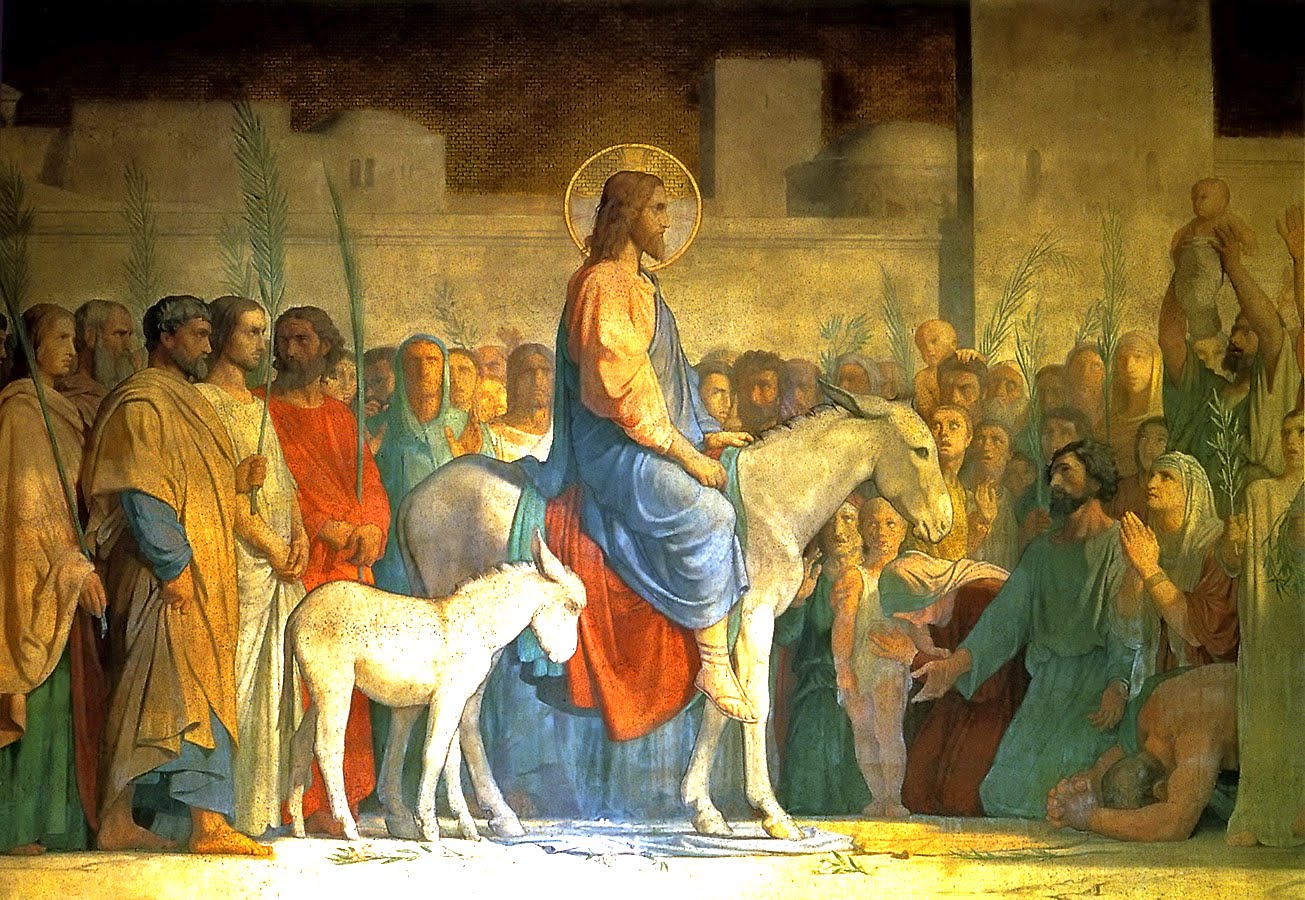
Domingo de Ramos...Triumphal Entry


En principio, no tenía intención de añadir comentarios personales  a mis posts de Semana Santa, pero no puedo resistir la tentación de subrayar cuan entrañable es para nosotros el Domingo de Ramos y la procesión de la Pollinica.

Cuando vivíamos en Arroyo de la Miel nunca nos perdimos el corto viaje a Málaga cada mañana de Ramos, con mis hijos, entonces pequeños, para ver la procesión;  yo les explicaba que representaba la llegada de Jesús a Jerusalén y como la gente le recibió con gran alegría y celebración. No les conté, ya que la  vida ya se encarga de ello, que detrás de aparatosas bienvenidas suele haber puñaladas escondidas esperando, tal y como le aconteció al protagonista de esta historia en Jerusalén.

También es un entrañable recuerdo de mi propia niñez en Madrid, donde no íbamos a la procesión pero si a bendecir las palmas. Siempre las recordare, largas y amarillas, lisas sin bucles. Después las traíamos a casa y se colgaban en los balcones.

Esta es una semana muy emotiva, y para nosotros de mucha añoranza de nuestra tierra, los viajes al pueblo de mi mujer, Cañada Catena, para pasar las fiestas con la abuela, las procesiones que veíamos en Canal Sur, la música y las saetas, la tortilla de pescado y el bacalao con acelgas y garbanzos…tantas cosas.


Comienza la Semana Santa…


Entry into Jerusalem - Giotto di Bondone - 1306


Y los discípulos fueron, e hicieron como Jesús les mandó;
y trajeron el asna y el pollino, y pusieron sobre ellos sus mantos; y él se sentó encima.
Y la multitud, que era muy numerosa, tendía sus mantos en el camino; y otros cortaban ramas de los árboles, y las tendían en el camino y la gente que iba delante y la que iba detrás aclamaba, diciendo: !Hosanna al Hijo de David! !Bendito el que viene en el nombre del Señor! !Hosanna en las alturas!
Cuando entró él en Jerusalén, toda la ciudad se conmovió, diciendo: ¿Quién es éste?
Y la gente decía: Este es Jesús el profeta, de Nazaret de Galilea.

 -- Mateo 21, 6-11 – Reina Valera 1960


La Pollinica - Procesiones de Málaga
     

La Pollinica - Málaga 2011 - Hoy mismo!


Christs entry into Jerusalem - Benjamin Robert Haydon - 1820


Entrada en Jerusalen - Pietro Lorenzetti - 1320


On the next day much people that were come to the feast, when they heard that Jesus was coming to Jerusalem,
Took branches of palm trees, and went forth to meet him, and cried, Hosanna: Blessed is the King of    Israel that cometh in the name of the Lord.
And Jesus, when he had found a young ass, sat thereon; as it is written,
Fear not, daughter of Sion: behold, thy King cometh, sitting on an ass's colt. 

-- John 12, 12-15 – King James Version


Entry of Christ to Jerusalem - Pietro Di Giovanni DAmbrogio - 1440


The Vaioforos - XIII century Icon at the Holy Monastery of Saint Catherine


Cuando llegó cerca de la ciudad, al verla,lloró por ella,diciendo:
--¡Si también tú conocieras, a lo menos en este tu día, lo que es para tu paz! Pero ahora está encubierto a tus ojos.
Vendrán días sobre ti cuando tus enemigos te rodearán con cerca, te sitiarán y por todas partes te estrecharán;
te derribarán a tierra y a tus hijos dentro de ti, y no dejarán en ti piedra sobre piedra,por cuanto no conociste el tiempo de tu visitación.

Lucas 19, 41-44, Reina Valera 1995


Paso de las Palmas - Procesiones de Avila


Palmas para bendecir - Madrid


...Vedla hecha largas varas
ante aras
en los templos, recordando que el Rabí a Jerusalén

fue triunfante en un pollino.


--Miguel Hernandez


Entrada de Jesus en Jerusalen - Pedro de Orrente Jumilla - 1620


Procesión de La Borriquita - Sevilla


…Atardecía entrando en Jerusalén,
Y suspiraba también la tarde cuando moría.
El olivo y la palmera…
Y Cristo sobre el pollino.
Que Jerusalén le espera
Alfombrándole el camino
Con una Cruz de madera…

--L. Jiménez Carrión


Jesus riding into Jerusalem - Jean Hippolyte Flandrin - 1842


The Holy Night


We sate among the stalls at Bethlehem;
The dumb kine from their fodder turning them,
Softened their horned faces
To almost human gazes
Toward the newly Born:
The simple shepherds from the star-lit brooks
Brought their visionary looks,
As yet in their astonied hearing rung
The strange sweet angel-tonge:
The magi of the East, in sandals worn,
Knelt reverent, sweeping round,
With long pale beards, their gifts upon the ground,
The incense, myrrh, and gold
These baby hands were impotent to hold:
So let all earthlies and celestials wait
Upon thy royal state.
Sleep, sleep, my kingly One!

by Elizabeth Barrett Browning


En route to a communist prison camp, missionary Geoffrey Bull spent Christmas Eve in a Tibetan Inn:

“After a meal, and when it was already dark, it was necessary for me to go downstairs to give more hay to the horses. Chien permitted my going and I clambered down the notched tree trunk to the lower floor, which was given over in the usual manner to stabling. Below, it was absolutely pitch black. My boots squelched in the manure and straw on the floor, and the fetid smell of the animals was nauseating. I felt my way among the mules and horses, expecting to be kicked at any moment. ‘What a place,’ I thought. 

“Then, as I continued to grope my way in the darkness toward the gray, it suddenly flashed into my mind, ‘What’s today?’ I thought for a moment. In traveling, the days had become a little muddled in my mind. Then it came to me, ‘It’s Christmas Eve.’ I stood still, suddenly still, in that oriental manger. To think that my Savior was born in a place like this. To think that He came all the way from Heaven to some wretched eastern stable and, what is more, to think that He came for me. How men beautify the cross and the crib, as if to hide the fact that at birth we resigned Him to the stench of beasts, and at death exposed Him to the shame of rogues. God forgive us. 


“Love to the uttermost, love to the uttermost,
Love past all measuring His love must be;
From Heaven’s highest glory to earth’s deepest shame,
This is the love of my Savior to me.”


The Glory of Humility

I remember sitting one Christmas season in London listening to Handel’s Messiah, with a full chorus singing about the day when “the glory of the Lord shall be revealed.” I had spent the morning viewing remnants of England’s glory—the crown jewels, the Lord Mayor’s gilded carriage—and it occurred to me that just such images of wealth and power must have filled the minds of Isaiah’s contemporaries who first heard that promise.

The Messiah who showed up, however, wore a different kind of glory—the glory of humility. The God who roared, who if He so desired could order armies and empires about like pawns, this God emerged in Bethlehem as a baby who could not speak or eat solid food. This God who created all things became dependent on a teenager for shelter, food, and love.

Rulers stride through the world with bodyguards, fanfare, and flashing jewelry. In contrast, God’s visit to earth took place in a shelter for animals, with no attendants present and nowhere to lay the newborn King but a feed trough. Indeed, the event that divided history into two parts may have had more animal than human witnesses. As Phillips Brooks put it:

How silently, how silently, the wondrous gift is given!
So God imparts to human hearts
the blessings of His heaven.

In most religions, fear is the primary emotion when approaching God. In Jesus, God made a way of relating to us that did not involve fear. 

~ Philip Yancey


Related Posts Plugin for WordPress, Blogger...